
Kelli A Anderson

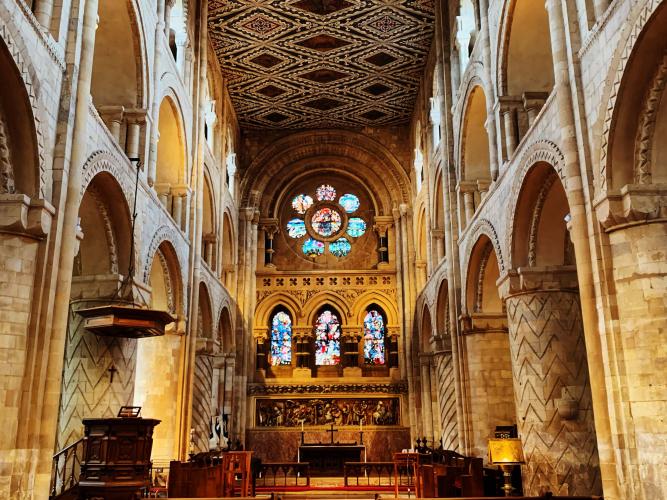
Today, I will discuss my research on the symbolic meaning of the carved spiral piers located near the high altar in Waltham Abbey's Church of the Holy Cross. This research stems from my masters dissertation, in which I attempted to reconcile the church's endlessly debated date of construction with its mutually exclusive historical records. The latter, which include a confirmation charter from Edward the Confessor dated 1062, a late 12th-century Chronicle, known today as the Waltham Chronicle, and the early 13th-century Vita Haroldi, do not necessarily support the assigned early 12th-century construction date, but instead suggest that the church was in fact built by Harold Godwinson at least six years before he became England's last Saxon King and died in the Norman Conquest of England in 1066. However, aligning with the church's assigned post-Conquest build date, scholars have unanimously agreed that the design of Waltham's spiral piers were inspired by those found in Durham Cathedral, which was begun in 1093. In this paper, I will first explore the potential precedents, symbolic meaning, and function of spiral piers or columns in art and architecture during the early medieval period, before I establish what the Holy Cross of Waltham was and how it may been perceived. Last, I will reconstruct the placement of the Holy Cross in relation to Waltham's spiral piers before suggesting that the piers themselves pre-date the Conquest of England and those seen in Durham.
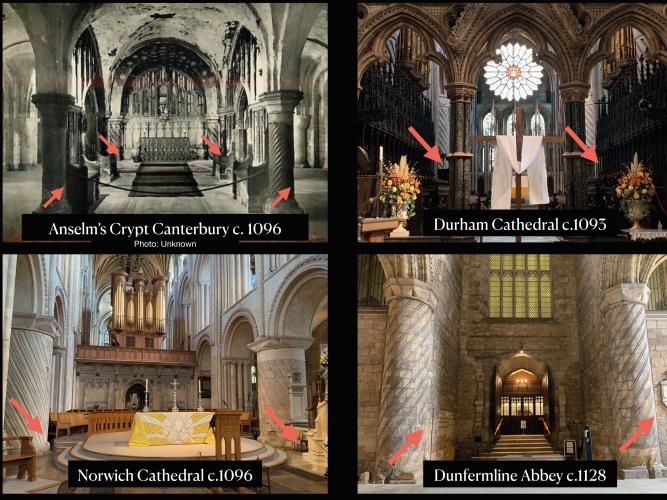
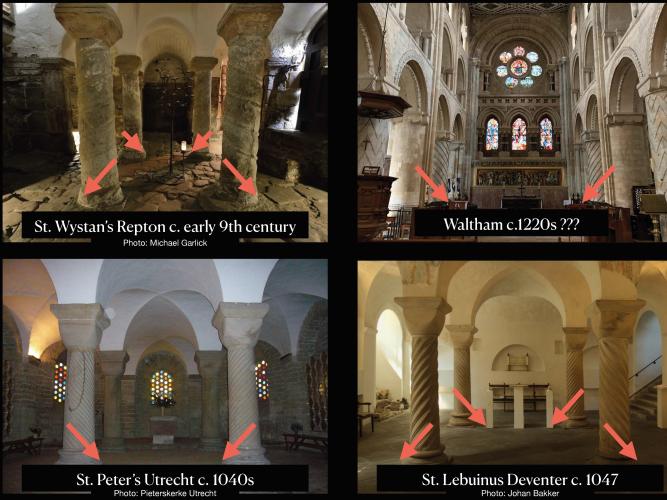
So what might be the Significance of the Spiral Piers? Most scholars have suggested that the spiral piers in Waltham are ornamental. Yet in the late 20th century, Eric Fernie proposed that their location near the high altar may have served a function by marking a sacred space. Existing parallels in the United Kingdom with piers in the main vessel of the church are only found at three other sites: the cathedrals of Durham and Norwich, and Dunfermline Abbey. With a hint of what is to come, you can see that only the spirals at Waltham in the converge, while all of the others turn harmoniously in one direction or the other.
Of these four locations, Durham's spirals are unique in that they do not appear in the nave but instead in the transepts and choir. Spiral columns, which have a different proportional system to piers, can be found in the crypts of the ninth-century St. Wystan's in Repton, Anselm's Crypt in Canterbury Cathedral, and on the other side of the channel in St. Peter's in Utrecht, and St. Lebuinus' in Deventer. Of these eight sites, St Wystan's is the eldest by nearly three hundred years and features a unique symmetrical space with four columns that create a pattern. Martin Biddle has proposed that the organisation of the spiral columns in this space, which is thought to have originally served as an underground baptistry with a drain channel through the east wall, is 'too complex to have been created by chance'. These observations by both Fernie and Biddle, regarding the potential function and significance of spiral piers or columns, have essentially served as the foundation of this study.
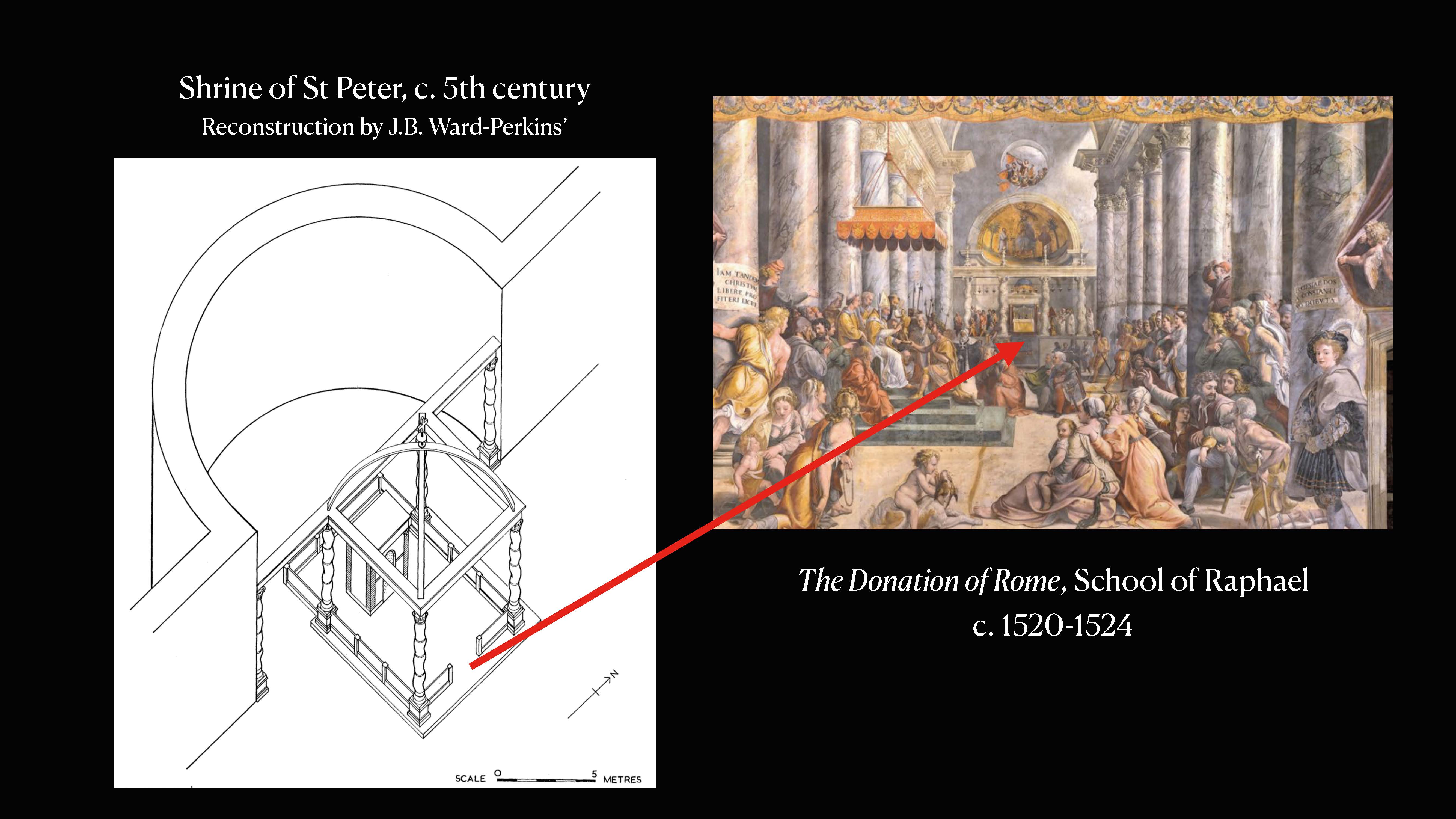
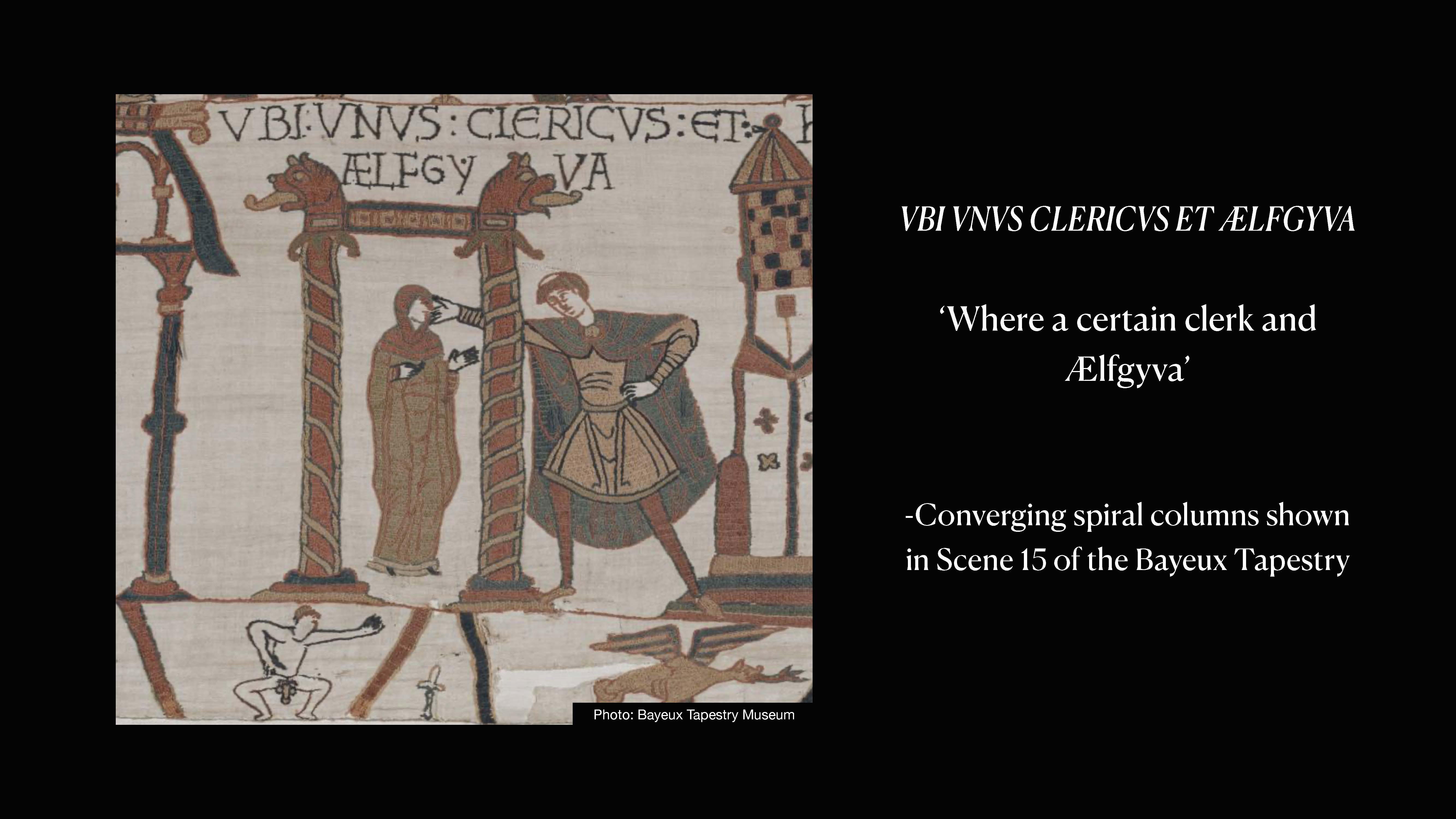
If we temporarily move away from the date bracket assigned to Waltham's piers, and instead look at the direction of each spiral pair, we can see that those found in the post- Conquest structures of Canterbury, Durham, Norwich, and Dunfermline turn in the same direction, while Repton's, Waltham's, Utrecht's, and Deventer's converge on an east/west axis and visually emphasise the central space between them. This orientation may have been inspired by the early-Christian adoption of Roman art found on sarcophagi, which often used strigillations and microarchitecture to add sensory appeal and cognitive signals. Converging strigillations in art visually encouraged individuals to focus on the image within the central space, which could then provoke contemplation. This compositional device, achieved through rhythmic strigillations and or spirals, was derived partially from architectural sources, and continued to be found in architectural contexts. A famous example, although we cannot be certain of the orientation or direction of the spirals, is the Early Christian aedicula at Old St. Peter's in Rome. The use of columns in this manner was intended to draw attention to the space and object that they framed, and indeed St. Peter's fame sparked many revivals of the motif throughout the Middle Ages and into the Renaissance. They appear in a wide range of other media, such as textiles, caskets, glass chalices, ivory, and coins, from the west to as far east as Syria, and often evoked subliminal messages that have left scholars debating their meanings to this day. One example is the converging spirals that were stamped on one of the last figural Islamic coins in Damascus around the year 697 -shortly before Abd al-Malik abandoned all figural representations for sacred inscriptions. By presumably removing the Christian cross and replacing it with what Luke Treadwell has suggested is Muhammed's spear, the Umayyad Caliph arguably expressed his power over Damascene Christians by altering or mutilating their religious symbol. Ælfgyva is framed by converging spirals in the Bayeux Tapestry, and as we all may know, the cryptic nature of Scene 15 compared to all of the others has sparked an eternal debate regarding what exactly had occurred.
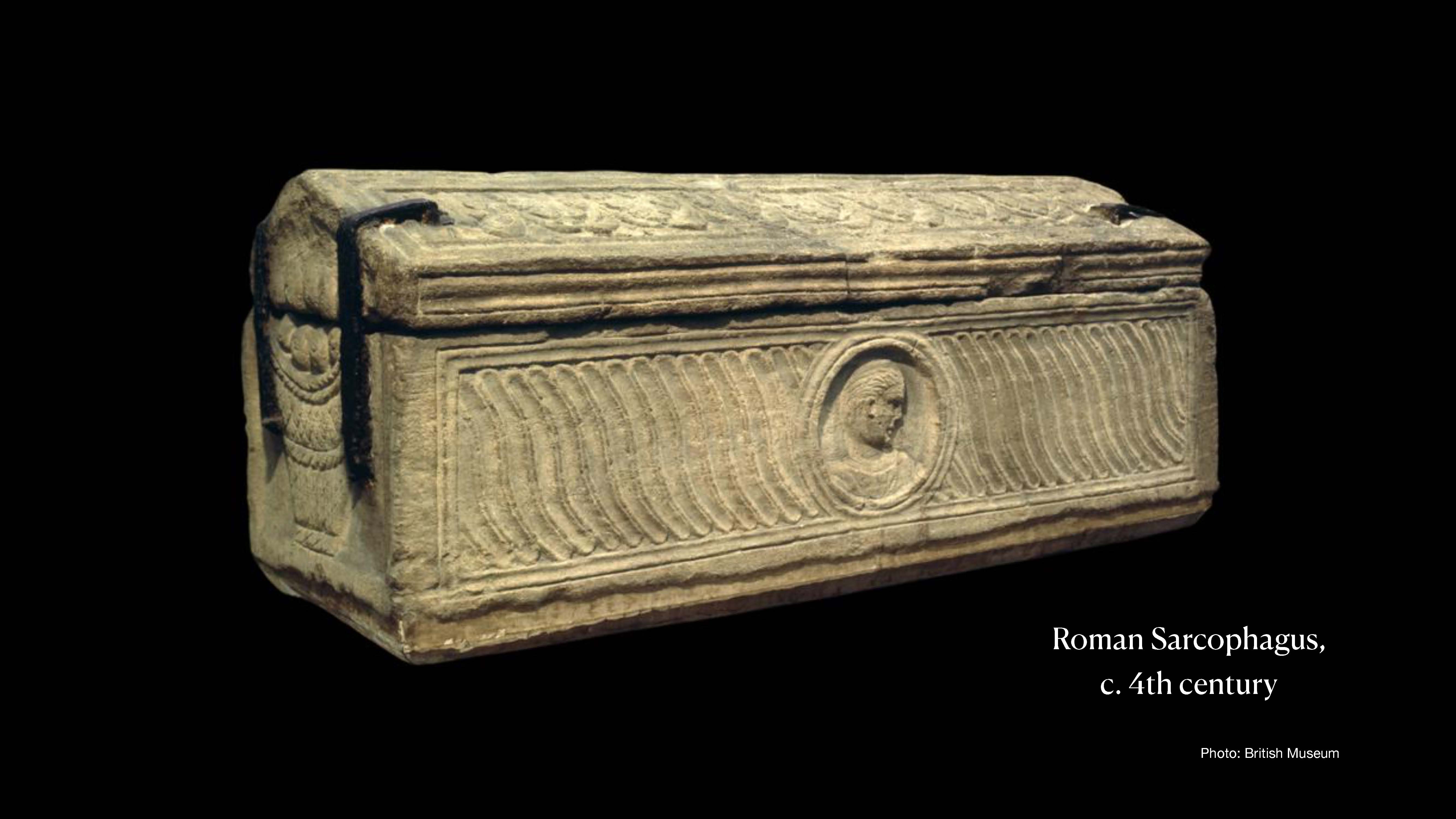
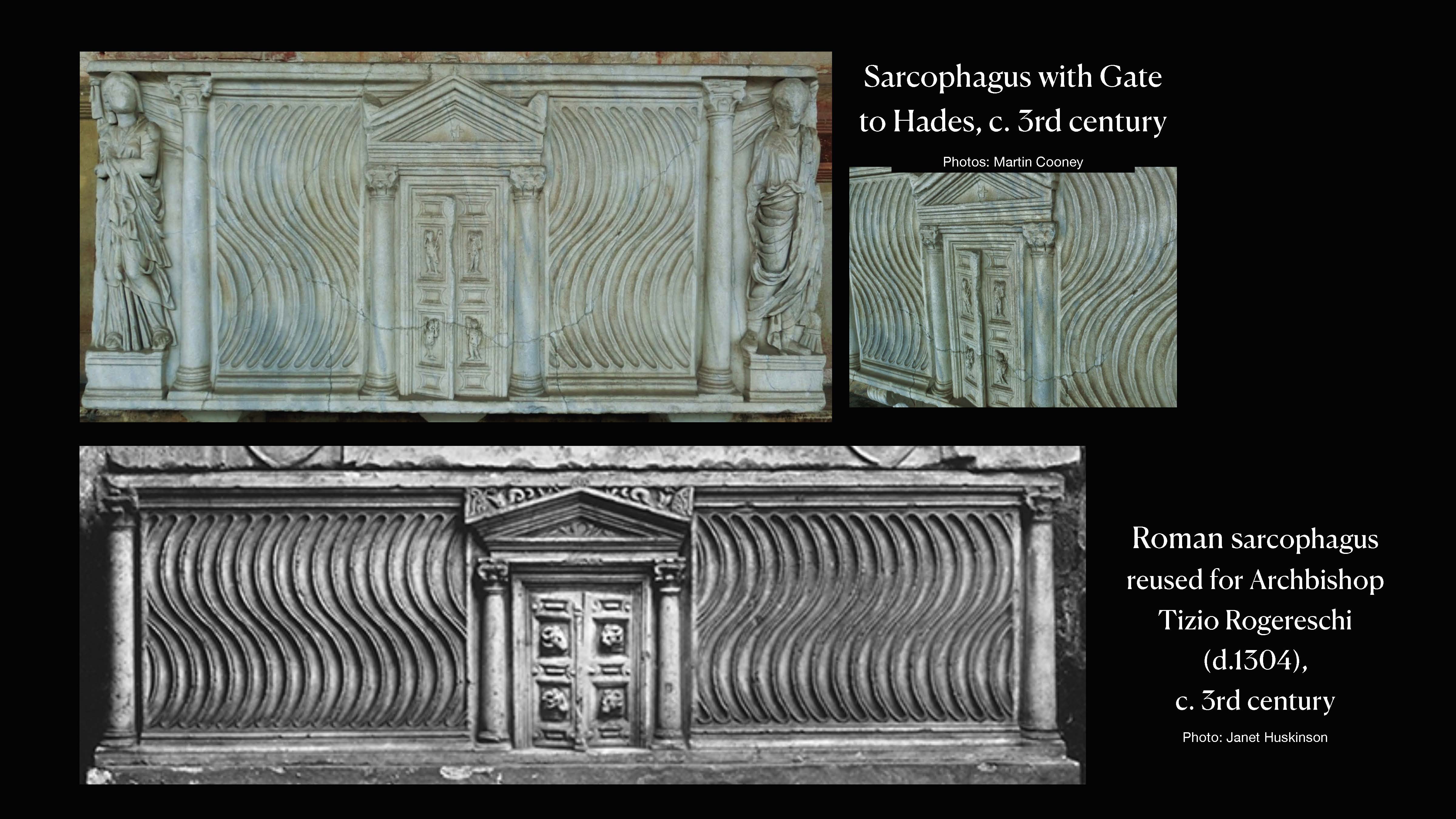
Before we continue, it should be said that strigillations do not always converge, like these appearing on this 4th-century Roman sarcophagus that was made in the British Isles. Yet, more often that not, Christian figures or scenes that feature Christ and or the Cross appear framed between converging lines, perhaps suggesting that artists were conscious of this compositional device and employed it to highlight the most important figure and or communicate to the viewer that he or she should focus on a central frame. Converging spirals and strigillations may have also had eschatological and metaphysical meanings. Strigillated lines mirror those that would appear on the body after ancient Greeks and Romans bathed and then scraped their skin with a tool called a strigil. Janet Huskinson has suggested that as an organic form, drawing from the curves of the human body and water, strigillations link to 'notions of spiritual refreshment and purification, [and furthermore, resembled the waves that] recalled the soul's symbolic sea journey to the "Isles of the Blessed"'. This interpretation may have been expressed best with sarcophagi. In Roman culture, the tomb itself served as an antechamber for the Gate of Hades, which often appeared as a central feature between strigillations or spiral columns. Christians appear to have adopted this iconography, possibly even refashioning it as the Gate to Heaven, or replacing it with early forms of Christian symbols that highlighted the path to redemption. With this in mind, the spiral piers in Waltham's nave were likely designed to accentuate the position of the church's most prized relic, The Holy Cross of Waltham, which may have then served to highlight a pathway or gate to Heaven through the act of worship and subsequent redemption.
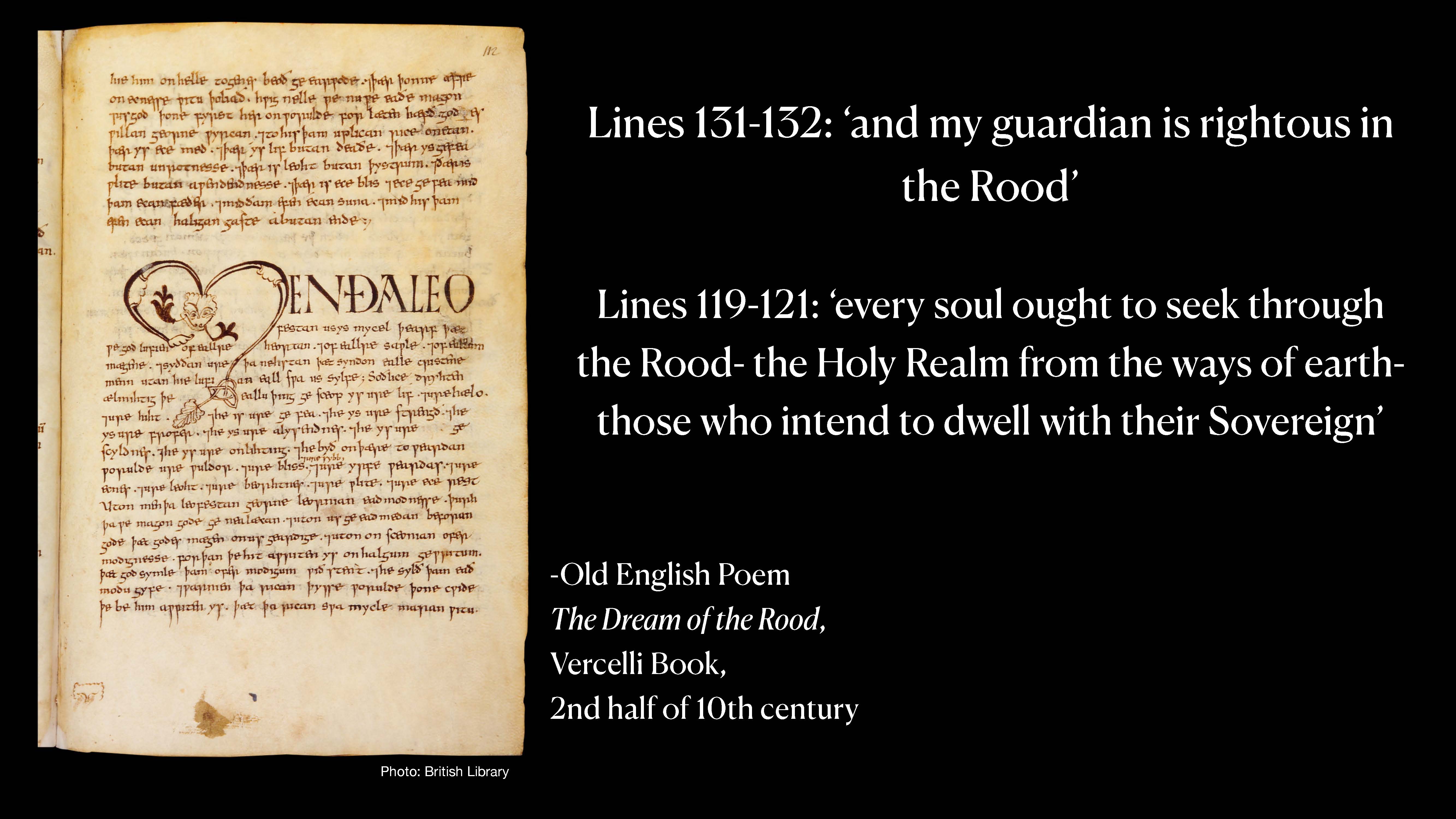
So what exactly was the Holy Cross of Waltham? This may seem like a rather silly question, but truth be told it is the central element of a legend that began nearly 1,000 years ago. Today, in Waltham Abbey, people may know of the Holy Cross but those I have spoken to could not give a clear account of what it may have been. We can gather from the Waltham Chronicle that sometime in or before 1042, a near to life-size crucifix made of black stone was discovered buried deep in a hill in Somerset and transported nearly 143 miles to Waltham by a powerful landowner named Tovi who served as standard bearer to King Cnut. Known as The Holy Cross of Waltham, this relic was believed to have had miracle-working powers, and is even said to have bowed its head to King Harold as he prayed before departing for the Battle of Hastings. This gesture, according to the author of the Chronicle, portended Harold's death. But it also recalls lines 40 to 43 in Old English Poem The Dream of the Rood when Christ 'climbed onto the high gallows. . . [and the Cross or Rood] quaked when the warrior embraced [him] yet dared not bow to the ground'. The author of the Chronicle appears to have known the poem and metaphorically used the sign of allegiance between Christ and the Cross to illustrate that Harold was not in God's favour. The personified Cross in the Dream of the Rood tells us that He and Christ were buried in a deep pit before being first discovered and then wrapped in gold and silver by thanes of the Lord. Aligning with the discovery of Waltham's Holy Cross attempts were made to adorn the relic with sheets of gold and gemstones but efforts ceased when the Cross began to bleed. These parallels between The Dream of the Rood and Waltham's Holy Cross stretch beyond the relic's discovery legend. The poem informs the reader or listener, in lines 131 to 132, that Christ is in the Rood 'and my guardian is righteous in the Rood', after it is declared in lines 119 to 121 that 'every soul ought to seek through the Rood- the holy realm from the ways of earth - those who intend to dwell with their Sovereign'.
These few poetic lines suggest that Waltham's relic may have been perceived as Christ himself on earth, especially considering that the Holy Cross was said to have moved and bled. If this were the case, then only through the relic could one seek redemption. By placing the Holy Cross in the nave of the church and centred between the converging spiral piers, Christians would have refashioned the imagery first seen on Roman sarcophagi, which again featured the Gate to the Afterlife framed in a similar fashion. Essentially, Waltham's spiral piers may have served to highlight the portal between a Christian's earthly domain and Christ's Heavenly Realm.
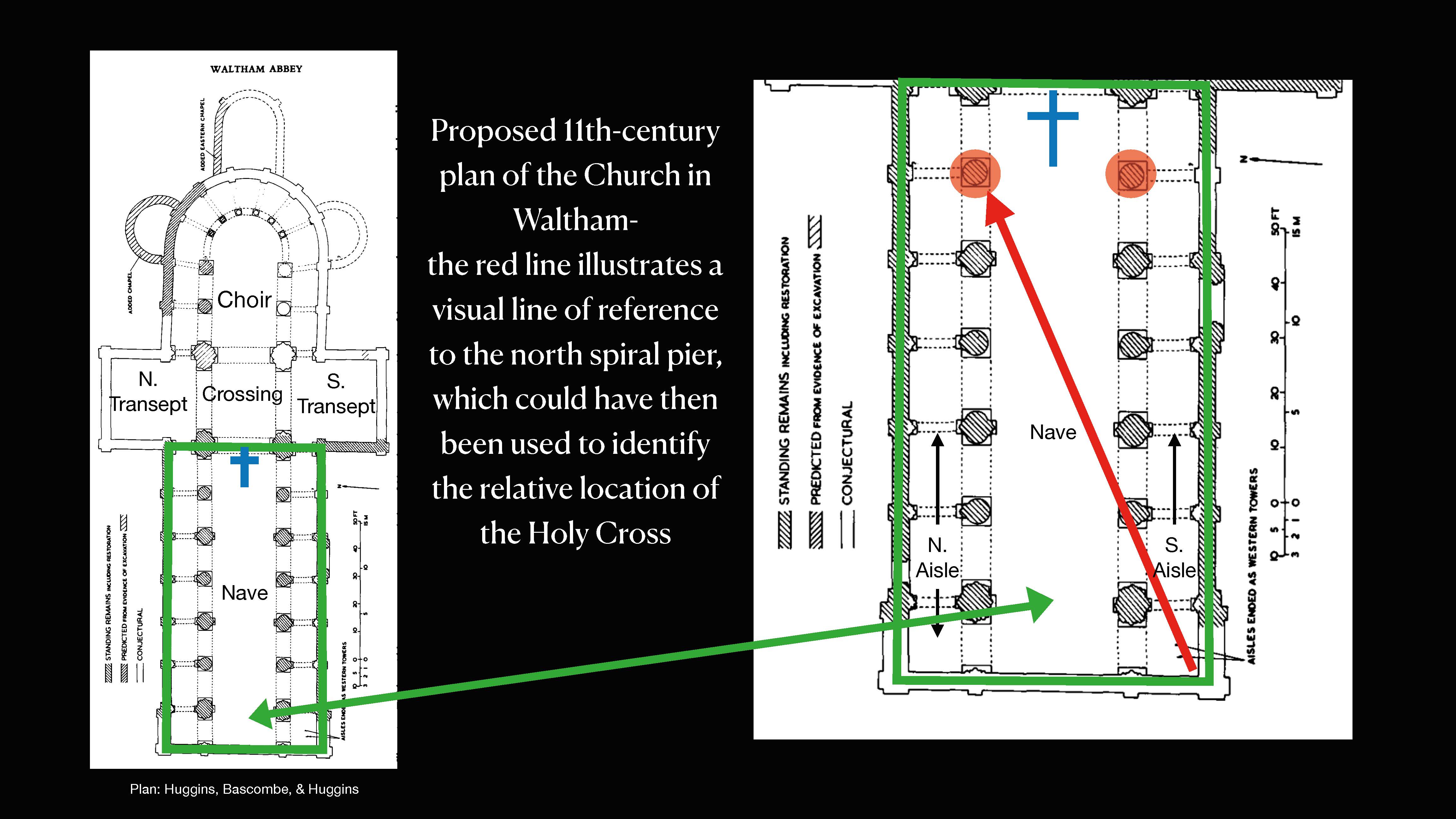
So where might the Holy Cross have been placed within the Church? The Waltham Chronicle informs us that efforts were made in the 1040s to illuminate the Holy Cross' location. Gytha, the wife of Tovi, is said to have placed a crown of pure gold embellished with precious stones upon Christ's head, a girdle of gold and gemstones around His loins, and a suppedaneum crafted of pure gold with a single illuminating gemstone below Christ's feet. The author of the Chronicle emphasises the importance of this gem's duty to glow 'when the night was dark and the lamps had been put out, so that it could provide a dim light for those on watch and illuminate the things they needed to see'. This account of the gemstone's purpose suggests that a conscious effort was made to emphasise the presence of the Holy Cross during the night as well as the day. Architecturally, the spiral piers could have only enhanced these efforts. The use of candles or lanterns at night surely would have created a sublime experience for those approaching Christ on the Cross, as the flickering of the lights bounced off the column shafts that appeared to be moving. Yet their placement, again, stretches beyond ornamentation. With circumferences that measure 2 to 3 feet larger than the other piers, the spirals project beyond the arcade. These measurements distinguish each spiral's precise location from all others, and also enables an individual to see at least one of them from all points of reference within the existing nave and aisles. For example, if an individual were to stand at the farthest point of the south aisle and face the direction of the altar, he or she would not have been able to see the Holy Cross itself - that is, if it were placed in the nave centred between the two spirals- but instead could have been able to identify the relic's proposed location in relation to the spiral piers. This placement of the Holy Cross in the nave, centred between the two spiral piers, and just in front of the altar; would have paralleled the location of other crosses or crucifixes during the mid-11th century.
In 1043, Ramsey Abbey had a cross positioned in the nave that was noted in a text describing the monks' celebration of Vespers. A charter entry pertaining to Canterbury states that Cnut placed his crown 'on the head of the great cross in the nave of the same church'. And excavations in Winchester have revealed three distinct foundations belonging to the Old Minster that were strategically located in the nave, between the western door and high altar, for the placement of either altars or crosses. It is therefore reasonable to propose that Waltham's Holy Cross was also located in the nave, and as we have seen with the adoption of Roman art by early Christians, centrally framed by the two spiral piers.
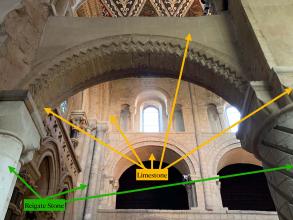
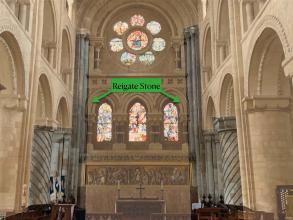
And now I must acknowledge the elephant in the room. Everything that I have discussed and presented to you thus far may appear plausible, but it does not conclusively attribute the spiral piers to Harold, nor does it confirm that their date and design respectively predate the Conquest and Durham. The existing nave in the church in Waltham Abbey does, in fact, appear to be a quintessential example of what many scholars consider to be post-Conquest Norman architecture. However, if you look at the easternmost bay of the existing nave from the north aisle and facing south, you can see that there is a break in material colour from a greenish-grey hue to a creamy yellow. These two distinct stone types, which include Reigate stone and either Barnack or Caen limestone, support the notion that a building break or remodel occurred in this area. During the late 1050s, when in fact the documentary evidence supports a build by Harold, Edward the Confessor was quarrying Reigate for the construction of Westminster Abbey. Edward had given Waltham's church, relic, and lands to Harold, and in turn, Harold founded a secular college, rebuilt the church, endowed it extravagantly with many relics, and then dedicated it to Edward. A Master Adelard was appointed to help establish and enforce the secular and ecclesiastical ordinances, customs, and rules of the church. Before arriving at Waltham, Adelard was educated in Utrecht, which is one of the other three locations previously discussed in this paper as having pre-Conquest converging spirals. If the spirals were built during Harold's lifetime and the Holy Cross was centred in the nave somewhere between them and the crossing, liturgical practices would have been able to continue from the crossing and around the Holy Cross while the church was later redesigned in the Norman style.
Without any documentary evidence supporting a post-Conquest build, or the existence of pre-Conquest churches in Normandy that feature converging spiral columns or piers, we should perhaps reconsider the date bracket assigned to the spiral piers in the Church of the Holy Cross in Waltham Abbey. All of the elements discussed here today, especially the difference in directionality between Waltham's and Durham's spirals and their locations within each church, suggest that the former may have actually inspired the latter.
Thank You